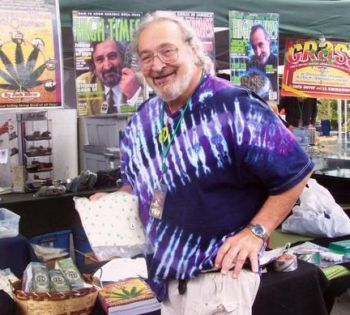
Jack Herer Continues His Fight to Educate the Public on Hemp and Cannabis!


Cannabis Classroom – Jack Herer’s Online School Of Cannabis Hemp – Opens Spring 2010

Jack Herer is surely a man who needs no formal introduction. A true hero amongst the Cannabis community and author of the greatest selling Hemp book of all times, “The Emperor Wears No Clothes”, Jack Herer has absolutely paved the way for the re-education of mankind about the truth regarding Cannabis Hemp. Even while resting and recovering from yet another heart attack, Jack is still on a mission to educate as many people as possible and help bring an end to marijuana prohibition. Luckily, with the help of Jack’s family and a few of his loyal followers, that mission continues!

Cannabis Classroom – Jack Herer’s Online School of Cannabis Hemp will open its doors in the Spring of 2010 and will start allowing a limited number of students around the globe to enroll. Cannabis Classroom is dedicated to the proper re-education of their students by providing an interactive online learning experience with an entire community of support. Getting the facts straight about Cannabis Hemp, students will be exposed to relevant information in relation to the History of Cannabis / Hemp, Cannabis Medicine / Science, Cannabis Law / Prohibition / Politics, Cannabis Cultivation and Cannabis Cooking. By completion of his or her training, the student will have gained an appreciation and deep understanding about Cannabis Hemp.

(POSITIONS AVAILABLE – Cannabis Classroom currently has a few amazing positions available for those interested in becoming Staff Instructors as well as the chance for all others to sign up as an Affiliate and earn commissions on those who may enroll.)

Cannabis Copilot, one of Cannabis Classroom’s co-founders, had this to say… “It’s all to raise awareness about this amazing plant while offering tremendous value to our wonderful community as well as to raise money for a few great causes.”

The founders of Cannabis Classroom have even agreed to give a percentage of their annual profits to a few different charity organizations whom are also dedicated to making a change on this green earth.

The free ‘Cannabis Crash Course’ is one of the ways in which they plan on providing great value to the community while spreading the word about Cannabis Hemp. This handy little Free Hemp Guide covers everything from the basic history of Hemp & how Cannabis has been used throughout each generation, to cultural industry icons such as Cheech & Chong, Jack Herer, Captain Ed Adair and of course High Times Magazine. Also touching on all of the different methods of medicating such as pipes, vaporizers, and even THC strips and sprays… The ‘Cannabis Crash Course’ is surely a must have!

Therefore, we encourage everybody to go and gain their 100% FREE access to ‘Cannabis Crash Course’ right away, which can be found online at www.SchoolOfHemp.com

For additional information contact: Admin@SchoolOfHemp.com


Nederland Voters Legalize Marijuana - Oust Mayor!


source: The Daily Camera (Boulder, CO)

Nederland became the second municipality in Colorado to legalize marijuana within its borders on Tuesday night.

The mountain town's residents went further than Breckinridge, which last year legalized possession of less than one ounce of marijuana, and by a vote of 259 to 218, removed all criminal penalties against buying, selling, possessing, consuming, growing and transporting marijuana for anyone age 21 or older.

Nederland voters also chose Trustee Sumaya Abu-Haidar to replace incumbent Mayor Martin Cheshes, making Cheshes the fourth mayor in a row to not win re-election.

Marci Wheelock, appointed to fill a vacancy just a few months ago, won election to her seat, along with newcomers Kevin Mueller, Chris Perret and Rob Joseph. When a new trustee is appointed to fill the vacancy left by Abu-Haidar, that makes for four new faces on the six-member Board of Trustees.

Boulder County law enforcement officials said the marijuana vote was largely meaningless because state laws against the non-medical use of marijuana remain in effect.

“The issues we focus on are drug-dealing and trafficking, and we don't get very many cases like that involving marijuana,” Boulder County District Attorney Stan Garnett said.

Boulder County Sheriff Joe Pelle, whose deputies work closely with Nederland town police, said his department enforces state, not local, laws.

“Marijuana enforcement for small quantities and personal use is not a priority for our department or for our community, but we'll continue to investigate and enforce trafficking," he said.

For "Michigan Mike" Torpie, who gathered the signatures to put the issue on the ballot, such distinctions miss the point.

"It's entirely symbolic, but it gets people's voice out there,” he said. “As more and more communities do this, it sends a message to the state legislature that people believe this to be largely harmless."

Garnett agreed about the political ramifications.

“I'll pay attention if it passes,” he said Tuesday afternoon, before the votes were counted. “Marijuana enforcement is a sensitive issue, and it's important to gauge public sentiment.”

Abu-Haidar, the mayor-elect, said she favors decriminalization of marijuana, but she thinks the initiative was a bad idea.

"We don't need to take this on at a local level,” she said. “We're a statutory town, so we're still bound by state laws. We have more important things to worry about.”

Melanie Dougherty, a stay-at-home mother of two who voted to decriminalize marijuana, said she knows overturning local laws won't change anything, but she still wanted to vote her conscience.

"I just don't like all the hoopla around it," she said after voting. "What people do in their own homes is their own business."

Town Clerk Christi Icenogle said turn-out was high, with 482 people out of a population of a little more than 1,300 people voting. Votes were counted by hand, and results were not released until after midnight.


Law Officers Feel War on Drugs Has Failed


source: contracostatimes.com


When the Assembly's Public Safety Committee voted 12 days ago to approve the legalization and regulation of marijuana in California, knee-jerk reactions were sure to follow.

This was only a first step toward legislation, but San Mateo police Chief Susan Manheimer quickly described the looming possibility as "mind-boggling."

John Lovell, speaking for the California Peace Officers Association, said it was "the last thing our society needs."

It wasn't hard to envision lawmen up and down the state nodding in agreement.

The viewpoint is understandable. It is part of the internal wiring of police agencies. The War on Drugs declared by President Nixon in 1971 has spanned four decades and seven administrations.

The thing is, it has failed. A far better idea is to legalize and regulate marijuana sales.

There are at least 1,500 current and former law enforcement professionals who agree. They are members of LEAP (Law Enforcement Against Prohibition), who base their opinions on years of experience.

Jack Cole, co-founder of the 8-year-old organization, is a retired New Jersey State Police lieutenant who served 12 of his 26 years on the job as an undercover narcotics cop. He describes the War on Drugs as "not only a dismal failure but a terribly destructive policy."

Norm Stamper, former Seattle police chief, used to kick in drug dealers' doors early in his 34-year career. His opinion: "It has cost the national treasury obscene amounts of money. And for what?"

James Gray, an Orange County Superior Court judge for 20 years, remembers sentencing one dealer after another to no perceptible end. "The closer you get to the issue," he said, "the more you see we couldn't do worse if we tried."

They liken the ban on recreational drugs to Prohibition, when the government's ill-fated attempt to end the sale of liquor created a lucrative industry for criminals. Sound familiar?

LEAP has packaged its argument in a convincing 12-minute video (www.leap.cc/cms/index.php?name=Content&pid=28), in which Cole explains that an estimated 1.3 percent of the U.S. population was addicted to drugs when the Harrison Act, a national anti-drug law, was enacted in 1914.

And 1.3 percent was believed to be addicted when the War on Drugs was unveiled. And 1.3 percent was addicted when a study was conducted in 2006.

So to sum up the 95-year battle against drugs: Nothing's changed.

The bootleggers and speak-easies that circumvented Prohibition have been replaced by drug cartels and street dealers. Far smarter than banning drugs would be government regulation.

"It's easier for teenagers to get marijuana than alcohol," Gray said. "That's because alcohol is regulated and controlled by the government, and illegal drugs are controlled by drug dealers. They don't ask for IDs."

In addition, dealers often recruit teenagers to sell. And when they do, they sell to other teens. "I've seen this too many times in juvenile court," he said. "I am determined to put an end to it."

James Anthony, a former Oakland prosecutor and member of LEAP, said the government errs in using a criminal justice approach to remedy a public health problem. Police should focus on public safety — stopping major crimes — not chasing bags of marijuana.

"I've worked closely with a lot of police officers who will admit, off the record, that the approach we're taking is not working and never will," Anthony said.

Among the obvious benefits to the proposed Assembly bill:

# Law enforcement resources allocated more wisely and a decline in the prison population.

# State revenues from sales taxes estimated at $1.4 billion.

# An end to the wrangling over medical marijuana.

# Revitalization of the hemp farming industry.

# Deglamorization of marijuana for recreation.

Gray calls the last bullet point the "Holland effect," noting that legalizing marijuana in The Netherlands has lessened its appeal: Per-capita consumption is only half what it is in the United States.

"They have succeeded in making marijuana boring," he said.

It would be foolhardy to suggest that change will come without cost. Even advocates concede there will be an initial uptick in users. The curious will inhale this opportunity.

Anthony said there might also be a knee-jerk reaction from drug dealers deprived of income.

"If people can't make a living selling marijuana in the underground market," he said, "you may see a spike in other crimes of economic opportunity — muggings, car burglaries, that kind of thing. We have to look at society as a total system."

Legalization represents a major reversal in policy, but that doesn't make it bad. When you find out you've been going in the wrong direction, the smart thing is to turn around.

NORML reports: Over 2,500 Subjects Since 2005 Have Used Marijuana-Based Medicines In Controlled Clinical Trials


source: NORML.org

Researchers worldwide have performed 37 separate clinical trials assessing the therapeutic safety and efficacy of inhaled cannabis and marijuana-based medicines since 2005, according to a review published online last week in the journal Cannabinoids: The Journal of the International Association for Cannabinoid Medicines (IACM).

Investigators from Leiden University in the Netherlands and the nova-Institut in Germany conducted a systematic review of recent clinical trial data pertaining to the medical use of whole smoked marijuana and cannabinoids.

Authors identified 37 controlled studies since 2005 evaluating the therapeutic effects of cannabinoids. The trials involved a total of 2,563 subjects.

Of the 37 clinical trials that have been recently conducted, eleven assessed the drug’s impact on chronic neuropathic pain – a difficult to treat type of pain resulting from nerve damage. Other studies assessed the efficacy of cannabinoids to treat multiple sclerosis-associated spasticity (nine separate studies); HIV/AIDS (four); experimental pain (four); intestinal dysfunction (two); nausea/vomiting/appetite (two); schizophrenia (two); glaucoma (one); and ‘other indications (two).

Authors concluded, “Based on the clinical results, cannabinoids present an interesting therapeutic potential mainly as analgesics in chronic neuropathic pain, appetite stimulants in debilitating diseases (cancer and AIDS), as well as in the treatment of multiple sclerosis.”

Last Wednesday investigators from the California Center for Medicinal Cannabis Research released the results of a series of double-blind, placebo-controlled trials that determined that cannabinoids could be “a first-line treatment” for patients suffering from neuropathy.

Commenting on the review, NORML Deputy Director Paul Armentano said: “The safety and efficacy of marijuana as a medicine has now been established by the ‘gold standard’ of clinical study. Further, over 2,500 patients have used cannabinoids in controlled clinical trials over the past five years alone. This is a far greater total than the number of subjects that would likely be administered any other new drug pending United States FDA approval, and is a large enough population to once and for all establish marijuana’s objective value as a medicine.”

Hawaii Legislature Consider Decriminalizing Marijuana


source: NORML.org

Possession of small amounts of marijuana would be decriminalized under legislation advancing through the state Senate.

The Senate Judiciary Committee passed a measure yesterday capping the penalty for possession of less than an ounce of marijuana at $100.

A separate bill that cleared its final Senate committee Monday would permit medical marijuana "compassion centers" to dispense the drug.

Both measures will be scheduled for votes before the full Senate next week, and if passed they would move to the House for further consideration.

Hawaii already has a medical marijuana law licensing patients to use the drug, but they're not allowed to buy it. The law allows patients to grow small amounts for personal use.

DEA Marijuana Seizures Nearly Double Over the Past Year

source: mainjustice.com

The total amount of marijuana seized by the Drug Enforcement Administration nearly doubled from 1,539 metric tons in fiscal 2008 to 2,980 metric tons in last year.

The numbers were disclosed as part of the DEA’s budget request for fiscal 2011.

A chart shows the flow of drugs into the United States (DEA).

A spokesman for the DEA declined to elaborate on the reason for such a dramatic rise in seizures of marijuana.

“Several factors play into this number and in any given year the amount of drugs seized by DEA can fluctuate,” said spokesman David Ausiello.

Aaron Houston, the director of government relations of the Marijuana Policy Project, a lobbying group that advocates the legalization of marijuana, said he suspected the increase was a result of drug seizures from cartels.

Despite Attorney General Eric Holder’s announcement that targeting individual users of cannabis for medical purposes was no longer a priority, the DEA budget request spoke dismissively of the benefits of medical marijuana, even placing the word patients in quotation marks.

“DEA does not investigate or target individual ‘patients’ who use cannabis, but instead the drug trafficking organizations involved in marijuana trafficking,” the request stated.

Houston applauded the Obama administration for its decision to stop raiding medical marijuana facilities in states that allow the practice. But said Houston, “on the rest of their drug policy, they’re on Bush administration auto-pilot.”

The DEA request said that there has been no Food and Drug Administration research that shows the benefits of medical marijuana. But the DEA has blocked such research from taking place, according to Houston. Just a few days before Obama was sworn into office, Houston said, the DEA refused to grant approval for a University of Massachusetts Amherst study into medical marijuana.

“It’s pretty cynical for DEA to claim on the one hand that we have to wait for the science to come in, and with the other hand literally block that research from happening,” said Houston.

The DEA’s full budget request is available on the Justice Department’s Web site.


Cannabidiol Inhibits Spread of Breast Cancer Cells


source: theexaminer.com


California Pacific Medical Center Research Institute Final Report (2008)

We discovered that cannabidiol (CBD), a non-psychotropic compound from the plant Cannabis sativa, can inhibit the process of breast cancer cells that allow them to grow and spread (metastasis). CBD can also inhibit breast cancer metastasis in a mouse model. The research carried out in our CBCRP proposal demonstrated that CBD is a novel inhibitor of a gene whose activity is intimately linked to the aggressiveness of human breast cancers; this gene has been termed Id-1. Notably, our findings also indicated that Id-1 was a key gene whose expression needed to be reduced in order for CBD to inhibit aggressive breast cancer. One of the most significant high risk components of the initial application was to determine if CBD had appreciable efficacy against breast cancer in vivo (i.e., animal models). This high risk component was not pursued, since an independent group showed CBD was able to inhibit metastasis of MDA-MB231 cells to the lung of nude mice. Building of the previous findings, we made small structural changes to CBD that are expected to produce drugs that are much more active than CBD at inhibiting Id-1 and corresponding aggressive breast cancers. CBD has a low toxicity profile. An anticancer agent with a low toxicity profile that can both inhibit cancer cell growth and metastasis would be extremely valuable clinically. Understanding the mechanisms behind the anticancer activity of CBD may also lead to the discovery of new biological targets for the development of diagnostic tools and additional therapies for the treatment of cancer. In this project we found portions of the CBD structure essential to its biological activity for breast cancer cell growth inhibition. We are in the process of filing a patent on these discoveries. In addition, we studies the moleculr mechanisms that underlie CBD activity, and found that sustained upregulation of Erk (extracellular signal-regulated kinases, a type of protein kinase intracellular signaling molecules) is key to the ability of CBD to regulate the metastasis-specific inhibition of the Id-1 transcription factor.

Antioxidant activity has been reported to be a general property of the phenolic components of marijuana. Unlike Δ9-THC, cannabidiol can be administered at relatively high doses without undesired toxic or psychological effects.1 Cannabidiol at a concentration of 10 µM was neuroprotective against both excitatory neurotransmitter (glutamate) and oxidant (hydroperoxide) induced neurotoxicity.

Read about Cannabidiol click here.

Cannabidiol Treatment For Cancer